
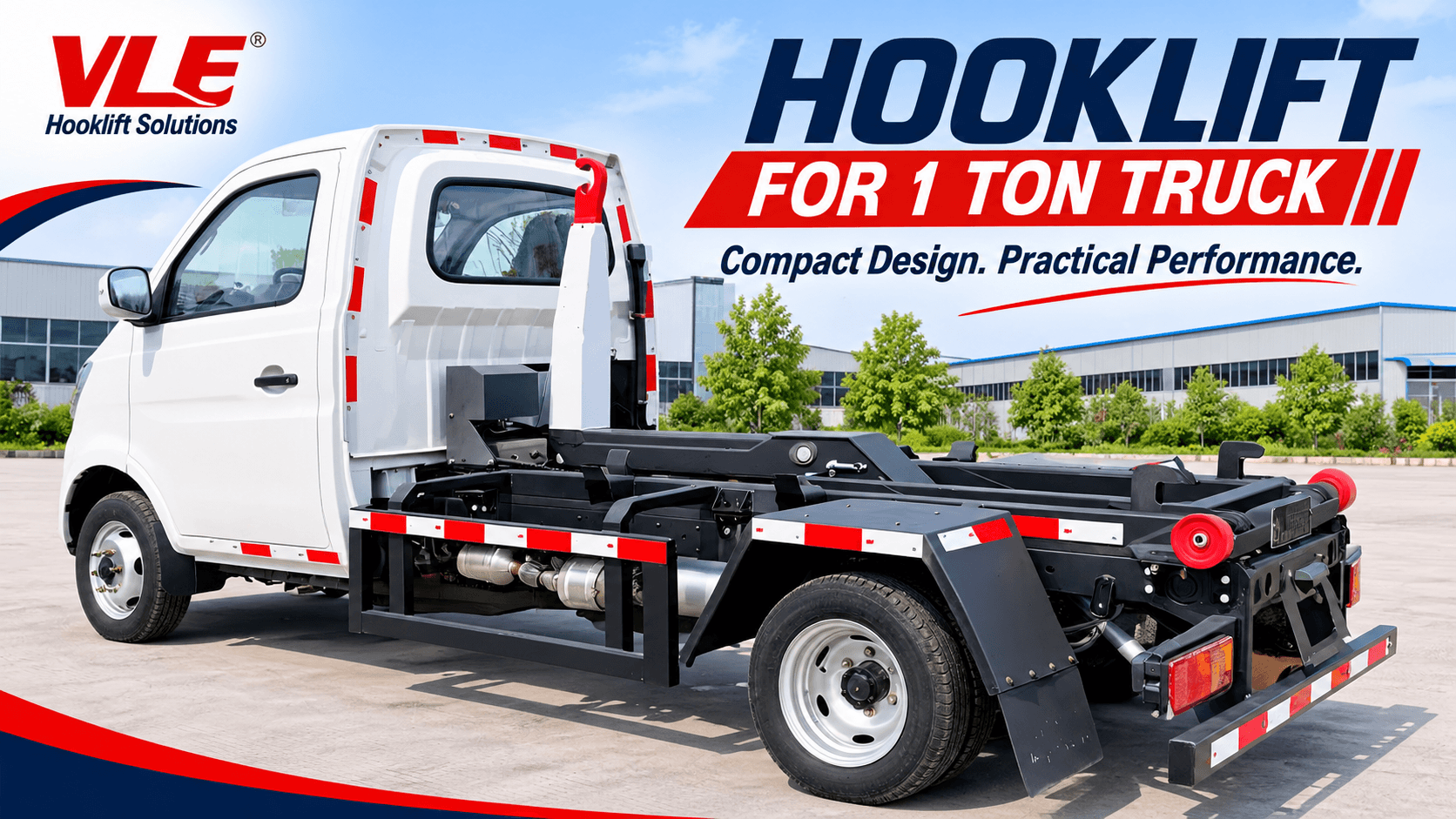
If your business operates a light-duty material handling, waste collection or specialized transport operation, a hooklift for 1 ton truck applications may be a good investment.
As a specialist in hooklift and hookloader systems, VLE offer a wide range of solutions for a variety of vehicle concepts, container requirements and commercial applications. From compact vehicle solutions to larger capacity hooklift systems, we can help you design a more flexible and efficient fleet.
In this guide, we will explain how compact hooklift systems work, what to consider when choosing equipment for a 1-ton truck, and how VLE Hooklift can support your business with practical hooklift solutions.
What Is a Hooklift for 1 Ton Truck Applications?
A hooklift is a specialized hydraulic lifting system that allows a vehicle to load, unload and exchange containers or bodies. Traditionally, if a truck had to transport various types of loads, a different vehicle would be required for each type of load. With a hooklift, a single truck can do the work of many.
For smaller commercial vehicle operations, a compact hooklift system allows for increased flexibility when working with light materials, or in confined spaces.
How Does a Hooklift System Work?
Most hooklift and hookloader setups use hydraulic power to move a lifting arm or carriage that then grabs a matching container.
The basic operating process includes:
- Positioning the truck
- Engaging the container
- Loading the container
- Securing the load
- Unloading or exchanging containers
The actual operating sequence depends on the hooklift design, safety interlocks, and manufacturer instructions.
But the actual order is not always identical , it depends on the hooklift model, safety interlocks and the manufacturer instructions you have to follow.
Why Consider a Compact Hooklift System for Your Business?
Compact vehicles are often the go-to option for businesses that need to reach narrow streets, residential access, small construction sites, or places where bigger trucks just can’t move smoothly.
The ISO 4413 standard for hydraulic fluid power systems provides general safety requirements for hydraulic systems and their components.
When properly matched to the vehicle, a compact hooklift system can provide several operational advantages.
1. Improve Vehicle Versatility
A hooklift-equipped vehicle can potentially handle multiple compatible container types instead of being permanently assigned to a single body.
Depending on the application, interchangeable bodies may support:
- Light waste collection
- Small-scale landscaping projects
- General material transport
- Equipment and tool storage
- Selected municipal or commercial collection tasks
This flexibility can help businesses organize daily operations more efficiently.
2. Make Better Use of Fleet Resources
A vehicle that can perform several compatible tasks may reduce the need for dedicated vehicles in certain light-duty operations.
3. Support Operations in Confined Areas
Shorter vehicles may be easier to maneuver through tight access roads and compact work sites than longer commercial trucks.
This makes short length hooklift trucks an option worth investigating for businesses that prioritize maneuverability.
4. Simplify Container Management
With a properly engineered system, operators can exchange compatible bodies instead of transferring materials manually between vehicles.
Understanding Short Length Hooklift Systems
Short length hooklift systems are kinda built for those vehicle and container setups that lean on compact sizing. They can be particularly relevant to operators who need practical loading equipment without the footprint of a large commercial hookloader.
When evaluating a short-series configuration, consider the following factors.
- Chassis Compatibility
- Hydraulic Performance
- Container Dimensions and Weight
- Loading and Unloading Clearance
What Is a Short Series Hooklift System?
A short series hooklift system generally refers to a compact configuration intended for applications where installation dimensions and vehicle layout are important.
The term does not represent one universal capacity or specification. Different manufacturers may use it to describe different designs, so buyers should always request the relevant technical drawings and performance data.
For a business considering a hooklift for 1 ton truck use, a short-series design may be an interesting starting point. However, a standard commercial hooklift should not be installed on a 1-ton vehicle without confirmation that the complete setup is technically suitable.
Key Specifications to Compare
When comparing compact hooklift solutions, request information about:
| Specification | Why It Matters |
|---|---|
| Rated lifting capacity | Establishes the system’s stated lifting capability under specified conditions |
| Truck GVWR | Determines the maximum permitted operating weight of the completed vehicle |
| Axle load limits | Helps prevent excessive loading on individual axles |
| Container dimensions | Confirms physical and mechanical compatibility |
| Hydraulic pressure and flow | Determines whether the truck can operate the system correctly |
| Installation dimensions | Helps confirm chassis and body compatibility |
| Safety features | Supports safe loading, unloading, and container retention |
| Maintenance requirements | Helps estimate long-term operating costs |
Do not select a system based on lifting capacity alone. The complete vehicle and equipment combination must meet applicable engineering, roadworthiness, and safety requirements.
VLE Hooklift: Hooklift and Hookloader Solutions for Commercial Applications
When purchasing lifting equipment for a commercial fleet, working with a knowledgeable supplier can make the selection process easier.
VLE Hooklift specializes in hooklift and hookloader systems, supporting businesses that need equipment for waste management, construction, agriculture, logistics, recycling, and other material-handling applications.
With experience in hooklift engineering and manufacturing, VLE focuses on helping buyers identify solutions that match their vehicle configurations and operating requirements.
Why Consider VLE Hooklift?
Businesses evaluating hooklift equipment can benefit from discussing their requirements directly with a supplier.
VLE Hooklift offers several points worth exploring during the selection process:
- Application-focused solutions: Discuss your intended use, vehicle specifications, container dimensions, and loading requirements.
- Multiple system configurations: Explore suitable straight, telescopic, articulated, or combined arm designs where appropriate for the application.
- OEM and customization options: Ask about product customization, branding, and configurations for vehicle manufacturers or truck modification companies.
- Technical guidance: Request specifications and compatibility information before committing to a purchase.
- Pre-sales and after-sales support: Discuss installation coordination, operating requirements, maintenance, and support arrangements.
For buyers looking beyond a single truck, VLE can also discuss hooklift solutions for different vehicle classes and commercial fleet requirements.
Important: A specific VLE hooklift model should only be selected for a 1-ton truck after its rated capacity, installation requirements, and compatibility with the proposed vehicle have been confirmed. Buyers should request written technical approval rather than assume that a standard model fits a light-duty chassis.
Common Applications for Compact Hooklift Trucks
Compact hooklift concepts may suit certain light-duty applications when the vehicle and system are appropriately engineered.
Waste Collection
Small collection operations may benefit from compatible containers for selected light waste streams. Operators should consider waste density, container volume, collection frequency, and local vehicle-weight restrictions.
Landscaping and Gardening
Landscaping contractors may need to move green waste, branches, and gardening materials between sites. A suitable container system could help organize collection and disposal activities.
Small Construction Projects
Compact vehicles can be useful on selected projects involving tools, light materials, and construction debris. However, heavy materials such as concrete and soil require careful weight calculations.
Municipal and Property Maintenance
Property maintenance teams may need flexible transport arrangements for equipment and approved collection containers.
For each application, the right solution depends on the actual truck capacity, material weight, loading conditions, and applicable safety requirements.
Frequently Asked Questions
1. Can I install a hooklift on a 1-ton truck?
Possibly, but not every 1-ton truck is suitable. The chassis strength, GVWR, axle ratings, hydraulic capability, and remaining payload must be checked against the selected hooklift system. Consult the vehicle manufacturer, qualified installer, and hooklift supplier before proceeding.
2. What are the benefits of short length hooklift trucks?
Short length hooklift trucks can be easier to maneuver in confined spaces and may suit selected light-duty applications. Their usefulness depends on the vehicle’s dimensions, container compatibility, permitted payload, and the type of work being performed.
3. What is the difference between a hooklift and a hookloader?
The terms are commonly used interchangeably to describe equipment that uses a hook and a lifting mechanism to load, unload, or exchange compatible containers. Specific designs and terminology can vary by manufacturer.
4. How do I choose the right short series hooklift system?
Start with your truck specifications, container dimensions, maximum loaded weight, hydraulic requirements, and intended application. Request technical drawings and written compatibility confirmation before purchasing.
5. Where can I find hook lift trucks for sale or a suitable hooklift supplier?
Contact hooklift manufacturers and authorized equipment suppliers to discuss your vehicle requirements. VLE Hooklift provides hooklift and hookloader solutions for commercial applications. You can email sale@vlehooklift.com to request product information and discuss your project.
Conclusion
Choosing a hooklift for 1 ton truck applications requires careful planning. Although compact hooklift systems can offer flexibility for selected light-duty operations, the equipment must be compatible with the truck’s chassis, hydraulic system, axle ratings, and payload limitations.
For fleet managers, waste disposal companies, and construction contractors, the best investment is a solution that meets real operational needs while maintaining safety, reliability, and long-term value.
VLE Hooklift specializes in hooklift and hookloader systems for a range of commercial applications. Whether you are investigating short length hooklift systems, comparing configurations for a vehicle modification project, or sourcing equipment for a larger fleet, the VLE team can help you explore the available options.
Ready to find the right hooklift system for your business?
Contact the VLE Hooklift sales team to discuss your truck specifications, container requirements, and application needs.
Email: sale@vlehooklift.com
Work with VLE Hooklift to explore a practical, application-focused solution for your next project.


